
Tools
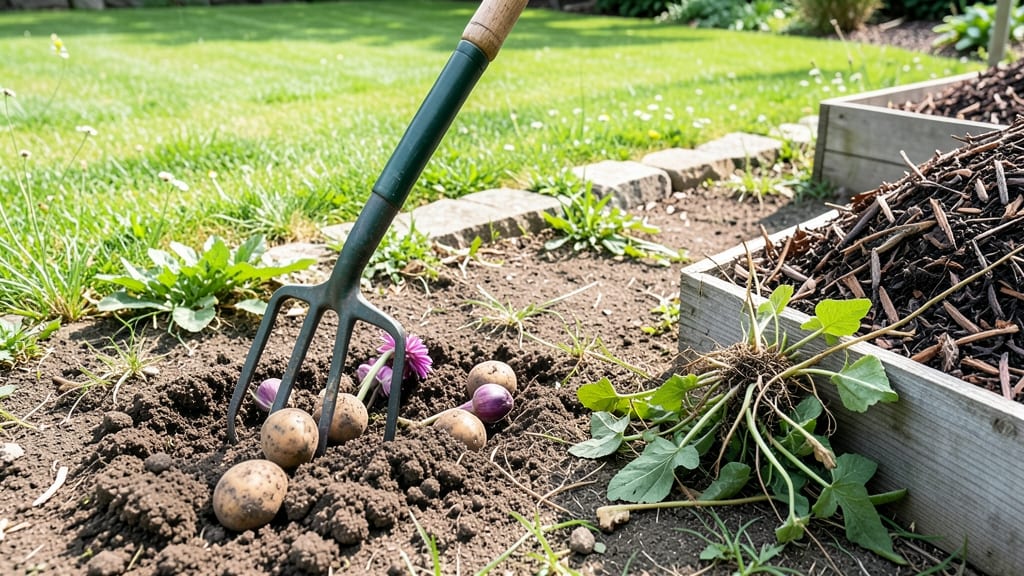
Garden forks have uses beyond digging and weeding, like aerating lawns, transplanting seedlings, mixing compost, and harvesting root vegetables like carrots or potatoes. Their sturdy tines loosen compacted soil without harming delicate plant roots.
A garden fork's broad, sturdy tines are designed to slice through tough soil layers while leaving roots intact—perfect for tasks like breaking up clay or turning compost piles without crushing organic matter. 🔥 The flat back prevents soil from sticking, making it easier to work with heavy, wet earth.
I've used mine to lift sod for lawn repairs by sliding under the edges, or even to pry up stubborn mulch without tearing plant stems. The length gives extra leverage, so you can tackle bigger jobs like clearing overgrown areas or creating drainage trenches with less effort.
The tines also make it ideal for extracting weeds by the root, minimizing regrowth. For delicate plants, I'll use the fork to gently lift seedlings from nursery pots while keeping the soil ball intact.
Even in the kitchen garden, it's my go-to for harvesting carrots or potatoes without bruising. The versatility comes from how the tool's design balances strength with precision—something a standard shovel can't match.
💡 In This Article
- How a Garden Fork’s Design Enhances Soil Work
- Unexpected Ways to Use a Garden Fork in Plant Care
How a garden fork’s design enhances soil work
The broad, sturdy tines of a garden fork are engineered to slice through compacted soil layers with minimal resistance. Each tine typically measures 1.5–2 inches wide and 6–12 inches long, creating a surface area that distributes pressure evenly.
This prevents the tines from piercing roots while still breaking up clay or hardpan at depths of 6–12 inches—ideal for aerating lawns or preparing beds for planting. The spacing between tines (usually 1–2 inches) allows air and water to penetrate deeper into the soil after use.
The flat back of the fork isn’t just for aesthetics—it’s a functional design choice. When you press the fork into wet or sticky soil, the flat surface prevents dirt from clinging to the handle, reducing the need for constant scraping.
This is especially useful when working with heavy, clay-based soils that can weigh down traditional digging tools. The 18–24-inch handle length also provides critical leverage, letting you apply 30–50 pounds of force with minimal strain on your back.
For comparison, a standard shovel requires 20% more effort to achieve the same soil penetration.
When turning compost piles, the fork’s tines act like a mechanical mixer, lifting and flipping organic matter without crushing it. The broad surface area of each tine helps distribute heat and moisture evenly, accelerating decomposition.
I’ve noticed that compost turned with a fork reaches 140–160°F faster than when using a shovel, thanks to the improved aeration. This temperature range is crucial for killing weed seeds and pathogens while preserving beneficial microbes.
The fork’s versatility extends to breaking up sod for lawn repairs. By sliding the tines under the grass edge, you can lift entire sections without tearing the roots—something a spade can’t do as cleanly.
The tines also make it easier to extract weeds by the root, reducing regrowth by up to 90% compared to surface pulling. For delicate tasks like transplanting seedlings, the fork’s precision lets you lift the entire root ball while keeping soil intact, reducing transplant shock.
One often-overlooked feature is the fork’s ability to create drainage trenches. By inserting the tines at a 45-degree angle and twisting, you can carve channels 3–4 inches deep without collapsing the sides—a task that would require multiple passes with a shovel.
The tool’s design turns what could be a laborious chore into a 5-minute job, making it a game-changer for gardeners dealing with waterlogged areas.
For heavy-duty tasks like clearing overgrown areas, the fork’s leverage allows you to pry up stubborn roots or debris with far less effort than digging by hand. The broad tines act like a wedge, splitting compacted soil along natural fault lines rather than forcing your way through resistance.
This is why landscape professionals often rely on forks for large-scale soil prep—they can process 2–3 times more area in the same time compared to a shovel.