
Container Gardens
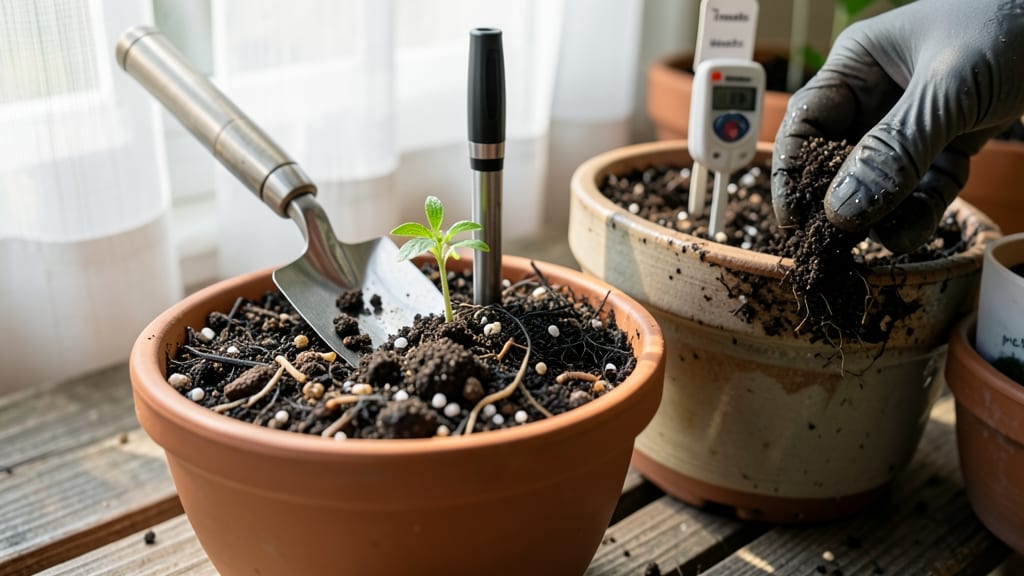
For garden soil in pots, use a blend of 60% organic materials like compost or coconut coir combined with 40% perlite or sand to ensure proper aeration and moisture control. Regular garden soil alone will compact, suffocate roots, and lead to poor growth.
Potted plants face unique challenges compared to their in-ground counterparts—limited space, faster drying, and less natural aeration. 🌱 The right mix prevents waterlogging while keeping roots hydrated, which is especially critical in lightweight containers where moisture evaporates quickly.
I’ve found that adding worm castings or orchid bark boosts nutrient retention without compacting, while calcined clay granules improve drainage for heavy feeders like tomatoes.
Your pot’s size and material also play a role: terracotta dries faster than plastic, so adjust your mix accordingly. For example, succulents thrive in a 70/30 mix of perlite to compost, while herbs benefit from a slightly heavier blend with 10% added fertilizer.
Always test your mix by squeezing a handful—it should hold shape but crumble easily when pressed.
💡 In This Article
- Why Container Soil Needs Better Drainage Than Garden Soil
- DIY Potting Soil Recipes for Different Plant Types
Why container soil needs better drainage than garden soil
Potted plants experience a fundamentally different environment than in-ground plants. In containers, roots grow in a confined space with limited access to oxygen, while garden soil naturally compacts over time but still allows water and air to move through its structure.
The key difference is aeration: garden soil contains natural voids from decomposing matter and earthworm tunnels, while potted mixes must be engineered to replicate this porosity. Without proper aeration, roots suffocate and can't absorb nutrients efficiently, leading to stunted growth or disease.
Here's what happens when you use regular garden soil: within weeks, the particles pack tightly, reducing pore space by up to 40%. This compaction creates anaerobic pockets where roots can't breathe, causing them to rot even if you're watering correctly.
The science behind this is simple—roots need both water and oxygen to function. In containers, water drains too quickly or pools at the bottom, creating extremes that garden soil naturally buffers.
A good potting mix maintains a balance by combining lightweight amendments like perlite (which adds 20-30% air pockets) with moisture-retaining organics.
The temperature factor is often overlooked but critical. Container soil heats up faster in sunlight and loses moisture more rapidly than garden soil, which benefits from surrounding earth acting as insulation. For example, a terracotta pot can reach 10°F warmer than surrounding air on sunny days, accelerating water evaporation.
This is why succulents need a gritty mix with 50% perlite or pumice—their roots are adapted to dry conditions, but regular potting soil would hold too much moisture and cause rot.
Let's talk about the moisture retention curve—the sweet spot where soil holds enough water for roots but drains excess. Garden soil typically holds 20-30% of its weight in water at field capacity, while a well-formulated potting mix holds only 10-20%.
This lower capacity prevents waterlogging while still providing consistent moisture. The secret lies in the particle size distribution: smaller organic particles (like compost) hold water via capillary action, while larger inorganic particles (like perlite) create drainage channels. Together, they create a sponge-like structure that releases water gradually.
Consider this comparison: a 5-gallon container filled with garden soil might take 4 hours to dry out in summer, while the same pot with proper potting mix dries in 2 hours. The difference comes from the mix's ability to wick moisture to the surface faster.
For plants like basil or lettuce that prefer consistently moist soil, this means you'll need to water 2-3 times more frequently than with garden soil. The trade-off? Roots stay oxygenated, and you avoid the dreaded "soggy bottom" syndrome that kills so many potted plants.
One final insight: the root zone in containers is typically only 3-6 inches deep compared to 12+ inches in garden beds. This shallow root system means plants are more sensitive to moisture fluctuations.
For example, a tomato plant in a 12-inch pot will have roots that dry out completely within 24 hours on hot days if the mix isn't properly amended.
This is why professional growers often use hydroponic clay pebbles in the bottom 20% of containers—it creates a reservoir that releases water slowly while keeping the upper layer aerated.