
Plants
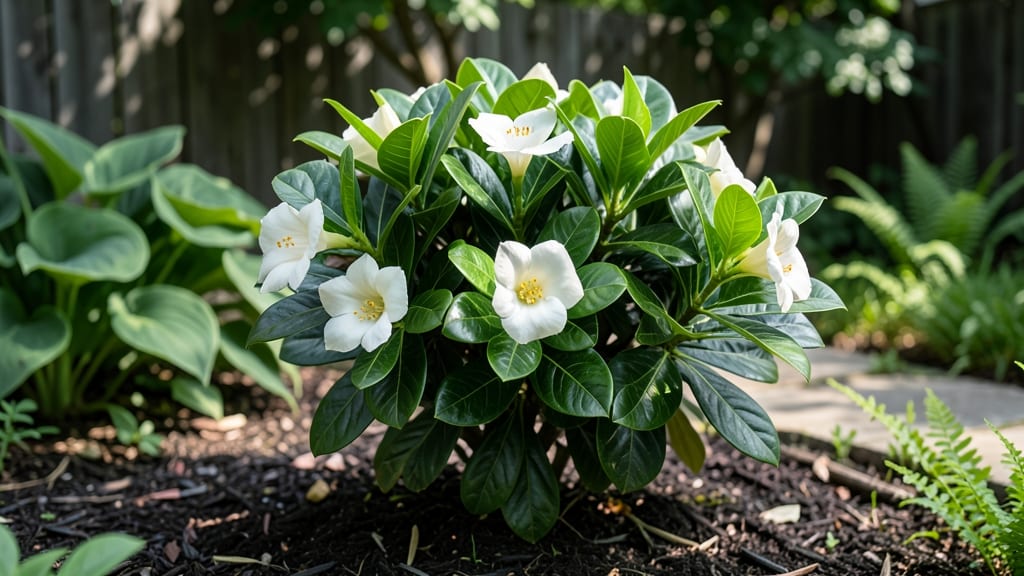
A gardenia plant looks like a lush, tropical shrub with deep green, oval-shaped leaves that have slightly serrated edges. It produces clusters of creamy-white, waxy-textured blooms in spring and summer, each with a rich, sweet fragrance that fills the air.
A gardenia's most striking feature is its thick, velvety petals that often appear slightly crinkled at the edges, giving them a luxurious, almost edible look. 🌸 The leaves—typically 2-4 inches long—grow in dense clusters along sturdy stems that can reach 6 feet tall, though many gardeners keep them trimmed to maintain shape.
Unlike jasmine or camellias, gardenias have a distinctive five-petal structure with prominent golden stamens at the center, which adds to their elegant appearance. The scent alone can help identify them, as few other plants produce that same intoxicating, floral aroma.
If you're trying to spot a gardenia in nature or someone's garden, look for these key traits: glossy leaves that stay vibrant year-round, upright growth habit, and blooms that appear in tight clusters rather than solitary flowers.
Many gardenias also develop small, orange-red berries after flowering, though these are less noticeable than the showy petals. The combination of visual and olfactory cues makes gardenias instantly recognizable to those who know what to look for.
💡 In This Article
- Gardenia Flower and Leaf Anatomy Explained
- Identifying Gardenia Plants in Gardens and Wild Settings
Gardenia flower and leaf anatomy explained
The gardenia flower's iconic beauty starts with its five-layered petal structure, where each petal measures about 1.5-3 inches wide and exhibits a velvety texture. The outer petals are slightly larger and more rounded, while the inner layers create a ruffled, almost pleated appearance.
At the heart, you'll find 15-20 golden-yellow stamens surrounding a prominent pistil, which gives the bloom its intricate, almost three-dimensional look. 🌸 The petals' waxy surface reflects light beautifully, creating that signature luminous quality that makes gardenias so photogenic.
Underneath the flowers, the leaves reveal their own architectural secrets. A mature gardenia leaf typically measures 2-4 inches long by 1-2 inches wide with a leathery texture that feels slightly rough to the touch.
The edges have fine, almost imperceptible serrations, and the leaf surface features prominent parallel veins that run from the central stem outward. This vein pattern helps distinguish gardenias from similar plants like jasmine, which has more delicate, net-like venation.
The leaves grow in dense, opposite pairs along the stems, creating a lush, compact canopy.
What's fascinating is how these traits vary between species. For example, Gardenia jasminoides (the most common variety) produces 4-inch-wide blooms with a stronger fragrance, while Gardenia augusta has smaller 1.5-inch flowers but thicker, darker green leaves.
The scent molecules—primarily jasmine and ionone compounds—are released through tiny pores on the petal surfaces, creating that intoxicating aroma that can be detected up to 30 feet away on a still day. This chemical process is what makes gardenias so effective in perfumery and aromatherapy.
When examining the stems, you'll notice their woody texture and reddish-brown coloration, which becomes more pronounced with age. Young stems are green and flexible, while mature ones develop a slight zigzag pattern where leaves attach.
This growth habit helps gardenias support their heavy blossoms without bending. The combination of these structural elements—from the petal layers to the leaf arrangement—creates a plant that's both visually stunning and botanically sophisticated. 🌿
Here's what sets gardenia leaves apart from common lookalikes:
- Texture: Gardenia leaves feel thick and leathery (like a magnolia leaf), while jasmine leaves are thinner and more papery
- Venation: Parallel veins vs. jasmine's reticulate (net-like) pattern
- Arrangement: Opposite pairs on stems vs. camellia's alternate pattern
- Scent: Gardenias emit a sweet, creamy fragrance while jasmine smells more citrusy and floral
The flower's anatomy also explains why they're so prized in floral arrangements. The waxy petals hold their shape better than many other blooms, maintaining their pristine appearance for 5-7 days in a vase.
This durability, combined with their rich color and fragrance, makes them a favorite for weddings and luxury floral designs. The central stamens even collect nectar that attracts pollinators like bees and butterflies, though their primary pollination occurs through wind dispersal of their tiny seeds.