
Tools
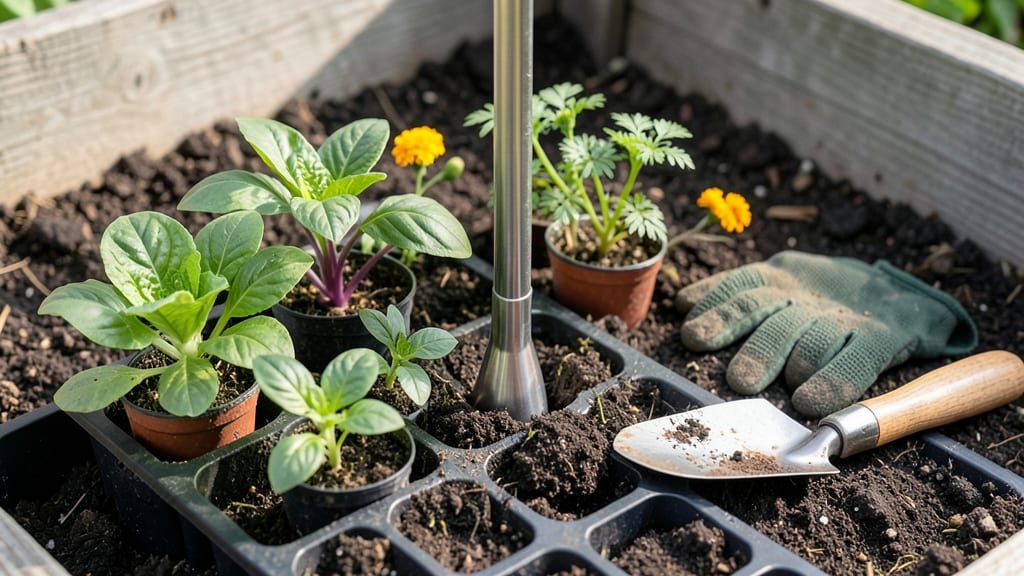
A dibber garden tool creates precise planting holes for seeds and small plants by driving it into soil with a mallet, ensuring proper spacing and depth without disturbing roots. Use it for bulbs, cuttings, or seedlings in rows or grids.
A dibber garden tool transforms messy planting into a clean, organized process by eliminating guesswork. 🌱 The pointed tip lets you create uniform holes—critical for seeds that need specific depth (like marigolds, which should sit just below the soil surface) or delicate cuttings that can't handle rough handling.
Unlike fingers, which often create uneven indentations, a dibber delivers consistent results, especially in hard or rocky soil where hand-digging would compact the earth around roots.
For bulbs, I recommend pressing the dibber 1.5 times the bulb's diameter deep—this prevents them from floating upward during watering. The flat base also serves as a handy guide for spacing: line up the dibber's edge with your last hole to maintain even rows.
When transplanting seedlings, use the dibber to loosen soil around the root ball first, reducing shock from sudden exposure.
💡 In This Article
- How a Dibber Improves Planting Accuracy
- Best Dibber Techniques for Different Plant Types
How a dibber improves planting accuracy
The secret behind a dibber's precision lies in its simple yet brilliant design. The pointed tip (typically 0.5-1 inch long) creates clean, vertical holes without tearing soil fibers like fingers do. This matters because disrupted soil structure can compress around delicate roots, stunting growth.
The flat base acts as a depth guide—when pressed firmly, it stops at the perfect planting level, ensuring seeds like lettuce (which need 0.25-inch depth) or carrots (needing 0.5-inch) get exactly what they need. 🌱
Most dibbers feature a T-shaped handle for leverage, allowing you to drive them into hard or compacted soil with a mallet. This is where the magic happens: the mallet's force creates a tight hole that holds soil in place, preventing it from collapsing around roots during watering.
Compare this to hand-digging, which often creates irregular holes that can't maintain consistent spacing—critical for plants like onions that need 4-inch spacing between bulbs.
Depth consistency is especially vital for seed germination. Many seeds require darkness to sprout, and planting too deep (like 1 inch for beans instead of the ideal 0.5 inch) can prevent them from emerging.
A dibber's uniform holes eliminate this guesswork. The tool's pointed tip also minimizes soil disturbance in the planting zone, preserving beneficial microbes that help roots establish faster. 🔥
For bulbs and tubers, the dibber's precision becomes even more valuable. When planting garlic, for example, you want cloves 2 inches deep and 4 inches apart. A dibber creates holes that maintain this exact spacing automatically, while its flat base helps you judge depth visually.
The tool's rigidity also prevents the hole from widening during planting—something that happens frequently with hand-dug holes, leading to uneven plant spacing.
Consider the physics: when you press a dibber into soil, it displaces earth vertically rather than pushing it sideways (like fingers would). This vertical displacement creates a clean cylinder of soil that can be easily removed to make room for roots.
The tool's weight also helps it penetrate denser soils without requiring excessive force, making it ideal for heavy clay where hand-digging would be exhausting. 💫
The flat base serves a secondary purpose: it acts as a visual guide for spacing. Many dibbers have measurement markings along the handle, allowing you to maintain consistent distances between plants. For example, when planting tomato seedlings, you might use the dibber's 12-inch marking to ensure proper spacing.
This systematic approach reduces crowding and improves air circulation, which is crucial for preventing fungal diseases in leafy plants.