
How To
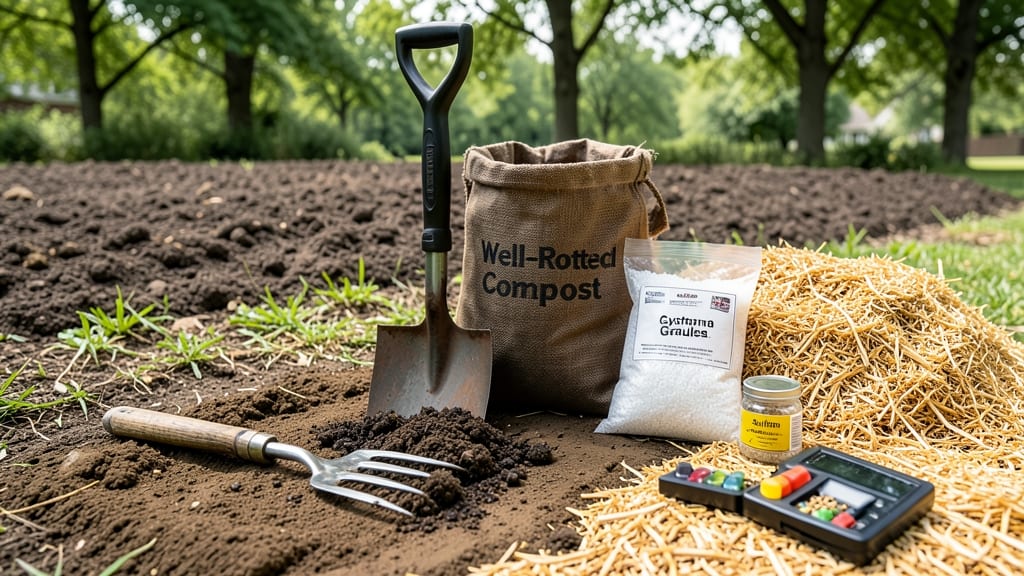
To fix clay soil for gardening, you'll need to incorporate organic matter like compost or aged manure, mix in coarse sand or perlite, and avoid walking on beds to prevent further compaction. Always test soil pH before amending for best results.
Clay soil's tiny particles pack tightly together, creating a dense matrix that traps water and blocks oxygen flow to plant roots.
This suffocating environment slows growth and makes drainage nearly impossible after rain. 🌱 The key to improvement lies in breaking up this compacted structure with organic materials that create air pockets while also improving nutrient availability.
I've found that layering amendments like compost and sand works best—think of it as giving your soil a breath of fresh air while loosening the grip on moisture.
Start by testing your soil's pH with a simple kit, as most plants thrive between 6.0 and 7.0. If your clay soil is too alkaline or acidic, you'll need to adjust it before adding amendments.
The goal is to create a balanced growing medium where roots can expand freely without battling waterlogged conditions. Remember, this isn't a one-time fix—regular maintenance with fresh organic matter keeps clay soil productive year after year.
💡 In This Article
- Why Clay Soil Struggles with Drainage and Root Growth
- Best Organic Amendments for Breaking Up Clay Soil
Why clay soil struggles with drainage and root growth
Clay particles are microscopic—typically 0.002 millimeters or smaller—creating a tightly packed structure that resembles dense ceramic tiles when dry. This extreme compactness gives clay its signature smooth, slick feel when wet, but it also makes water movement nearly impossible.
Unlike sandy soil, where water drains freely through larger gaps, clay holds 30-50% more water by volume, often leaving roots drowning in anaerobic conditions where oxygen levels drop to 5% or lower—a suffocating environment for most plants.
The real problem begins when clay dries. These tiny particles shrink and pull apart, creating deep cracks that can reach 3-6 inches deep. While this might seem like improved drainage, the cracks actually worsen compaction by allowing air to escape while trapping water in the remaining dense matrix.
This cycle of swelling and shrinking also destroys soil structure over time, making it harder for roots to penetrate. 🌱 What's worse, clay's high mineral content means it binds nutrients tightly, making them unavailable to plants despite the soil's rich appearance.
Compaction makes matters exponentially worse. Heavy foot traffic or machinery crushes the already dense particles, reducing pore space by 30-50% and creating a brick-like consistency. This physical pressure forces out air pockets that roots need for respiration, while also compressing the water storage capacity.
Even with ideal moisture levels, roots in compacted clay struggle to grow because they can't access the oxygen needed for cellular respiration—a process that powers root development and nutrient uptake.
Consider how this affects plant health: In compacted clay, roots grow horizontally near the surface rather than extending vertically, which limits a plant's ability to anchor itself and access deeper water reserves. This shallow root system makes plants more vulnerable to drought stress and toppling in wind.
The visual clue? Yellowing leaves and stunted growth despite regular watering—a classic sign of root suffocation in clay-heavy soils.
What most gardeners don't realize is that clay's natural fertility isn't the issue—it's the physical structure. Clay contains abundant nutrients like potassium and phosphorus, but these become locked away in the dense matrix. The challenge is creating pathways for both water and air to move freely while maintaining nutrient availability.
This is where organic amendments become essential—they act like tiny scaffolding, creating air pockets and channels that restore soil function.