
Tools
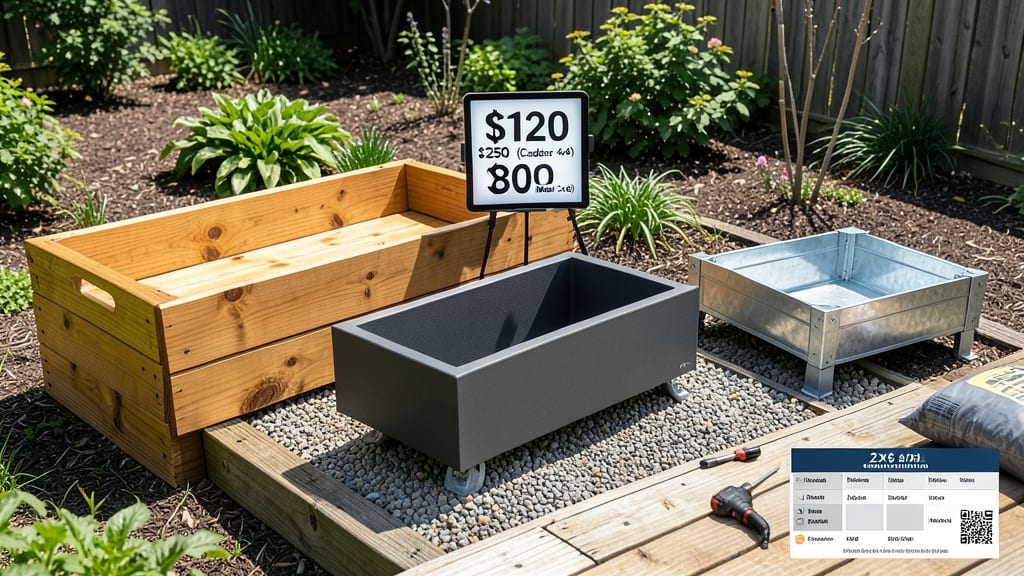
The price of raised garden beds ranges from $50 to $1,500+, depending on materials like cedar ($10–$30 per sq. ft.), composite lumber ($20–$50 per sq. ft.), or stone ($30–$70 per sq. ft.), plus size (4'x8' vs. custom). DIY kits cut costs by 30–50% compared to pre-assembled options.
Raised garden bed costs vary dramatically based on what you prioritize—durability, aesthetics, or ease of assembly. 🌱 Cedar beds offer natural rot resistance but cost more upfront, while treated lumber is budget-friendly but may require replacement every 5–7 years.
Stone edges add a premium look but can double material expenses for larger beds. I’ve seen 4'x8' cedar beds start around $200, while custom stone-lined designs easily exceed $1,200. The real savings come from DIY assembly, where pre-cut kits drop prices by nearly half compared to fully assembled units.
Location plays a surprisingly big role too. Prices in urban areas with higher labor costs can jump 20–30%, while rural regions often have cheaper lumber due to bulk discounts. Composite lumber (like cedar-plastic blends) lasts longer than traditional wood but costs nearly twice as much per square foot.
For budget-conscious gardeners, repurposing materials like cinder blocks or reclaimed wood can cut initial costs by 40%, though they may lack the polished finish of commercial options.
💡 In This Article
- Factors Influencing Raised Garden Bed Pricing
- Cost-Saving Tips for Buying Raised Garden Beds
Factors influencing raised garden bed pricing
The core cost driver is the material you choose, as each option carries distinct durability and maintenance trade-offs. Cedar remains the gold standard for natural rot resistance, thanks to its high tannin content that repels insects and moisture.
A 4'x8' cedar bed typically costs $200–$400 because the wood lasts 10–15 years with minimal treatment. In contrast, treated pine—common in budget kits—costs $100–$200 for the same size but may need replacement every 5–7 years due to chemical breakdown from weather exposure.
Construction complexity adds another layer. Pre-cut DIY kits with pre-drilled holes for screws streamline assembly but cost $50–$150 more than raw lumber bundles. The difference comes from precision-cutting services and included hardware.
Custom stone or brick edges can inflate costs by $300–$800 for a 4'x8' bed, as each stone requires individual cutting and mortar work. Regional lumber prices also swing wildly—urban centers often charge 20–30% more due to transportation costs, while rural areas benefit from bulk supplier discounts.
Labor costs become significant when you opt for professional installation. A contractor might charge $50–$100 per hour to assemble and level a bed, adding $200–$500 to your total. This is where DIY kits shine—they eliminate labor costs entirely while still delivering professional-grade results.
The time savings alone (most kits assemble in 2–4 hours) justify the 30–50% premium over raw materials.
Don't overlook the hidden costs of maintenance. While cedar beds require minimal upkeep, stone edges need periodic mortar repairs, and metal frames may rust if not galvanized. I've seen gardeners spend $100–$300 annually on replacements for low-quality materials that degrade faster.
The upfront savings on treated pine often vanish within 3–5 years when you factor in repeated repairs.
Size matters too, but not linearly. A 2'x4' bed might cost $120 in cedar, while doubling to 4'x8' jumps to $280–$400—not quite double because larger beds benefit from economies of scale in material pricing.
The real cost explosion comes with custom shapes or multi-tier designs, where labor and material waste can double the per-square-foot cost.
What most people miss is how bed height affects pricing. Standard 6–12-inch beds use 1x6 or 1x8 lumber, while 18–24-inch "lasagna-style" beds require thicker 2x6 or 2x8 materials, adding $50–$150 to the total.
The extra depth costs more upfront but pays off by reducing weed pressure and improving soil retention over time.