
Vegetables
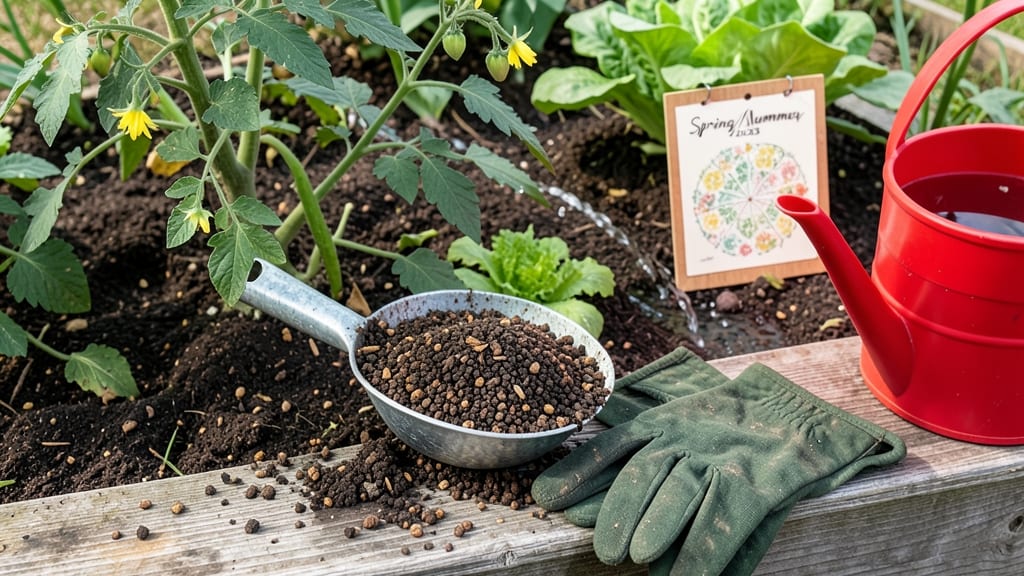
To fertilize a vegetable garden, time applications based on soil tests and crop types: add organic fertilizer in early spring before planting, feed leafy greens every 3-4 weeks mid-season, and use slow-release granules for root crops at planting and mid-growth. Adjust for your local climate and soil conditions.
Timing matters because vegetables deplete soil nutrients at different rates. 🌱 Early spring fertilization replenishes what winter leached away, while mid-season boosts support rapid growth. Leafy greens like spinach or lettuce need frequent feeding because they're heavy nitrogen users, while root crops like carrots benefit from gradual nutrient release.
The key is matching fertilizer types to each plant's growth stage—too much too soon can burn roots, while too little too late stunts production.
Your local climate plays a huge role too. In warm regions, you might fertilize twice as often as in cooler zones where growth slows. For example, tomatoes in Florida need more frequent feeding than those in Maine.
Always start with a soil test to identify deficiencies—this tells you whether you need more nitrogen for leafy growth, phosphorus for root development, or potassium for disease resistance.
💡 In This Article
- Understanding Soil Nutrient Cycles for Vegetable Growth
- Crop-Specific Fertilization Schedule for Common Vegetables
Understanding soil nutrient cycles for vegetable growth
Soil nutrients follow a natural cycle where plants absorb them during growth, and microbes break down organic matter to replenish what's lost.
Vegetables deplete key nutrients like nitrogen, phosphorus, and potassium at different rates—leafy greens like spinach can exhaust nitrogen in just 4-6 weeks, while root crops like sweet potatoes take 3-4 months to fully develop.
The challenge is that these nutrients don't stay available indefinitely; rain and microbial activity wash them away or convert them into forms plants can't access.
Seasonal temperature shifts dramatically alter nutrient availability. In spring, soil microbes become active at 50°F+, accelerating organic matter decomposition and releasing nitrogen. However, if temperatures spike above 85°F, microbial activity slows, and nutrients like phosphorus become less accessible.
This is why early spring fertilization is critical—it jumpstarts nutrient release before plants begin rapid growth. Slow-release fertilizers, like composted manure or coated granules, release nutrients gradually over 2-3 months, while fast-release options (like blood meal) provide an immediate nitrogen boost but require more frequent applications.
The optimal pH range for most vegetables is 6.0-7.0, where nutrients are most bioavailable. For example, tomatoes thrive at pH 6.2-6.8, while brassicas (like broccoli) prefer 6.0-7.0.
Soil pH affects how plants absorb nutrients: at pH 5.0, phosphorus becomes locked in the soil, while at pH 8.0, iron and manganese deficiencies occur.
Testing your soil in early spring reveals these imbalances, allowing you to amend with lime (to raise pH) or sulfur (to lower it) before planting.
Fertilizer type also dictates timing. Fast-release fertilizers, such as synthetic nitrogen (like urea), are best applied when plants show early signs of nutrient stress—yellowing leaves indicate nitrogen deficiency, while stunted growth suggests phosphorus or potassium shortages.
Slow-release options, like organic compost or osmacote granules, are ideal for long-season crops like squash or corn, as they provide a steady supply without risking over-fertilization.
The key is matching the fertilizer's release rate to the plant's growth cycle—too much too soon can burn roots, while too little too late stunts production.
Consider how your local climate influences these cycles. In regions with short growing seasons (like Zone 4), you might focus on early spring fertilization to maximize the brief window of active growth.
Conversely, in longer seasons (like Zone 8), you can stagger applications—starting in early spring, side-dressing in summer, and adding a final boost in fall for overwintering crops like kale. The goal is to align fertilization with the plant's natural growth rhythm, not just calendar dates. 🌱
One often-overlooked factor is how soil texture affects nutrient retention. Sandy soils drain quickly, requiring more frequent fertilization (every 3-4 weeks), while clay soils hold nutrients longer but may need amendments to improve drainage.
For example, adding 2-3 inches of compost to sandy soil before planting can double nutrient retention time. Understanding your soil's texture helps fine-tune your fertilization schedule—this is where a simple jar test (layering soil in water) can reveal whether your soil is sandy, loamy, or clay-based.