
Tools
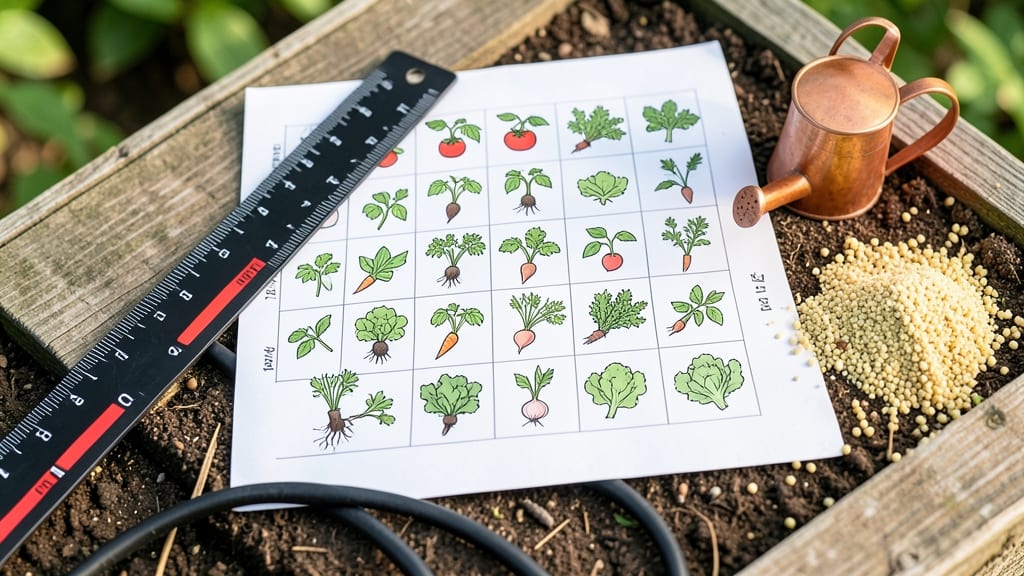
A sqft gardening chart helps you visualize how many plants of each variety can grow in a single square foot of space, ensuring optimal growth without wasting precious garden real estate.
A sqft gardening chart isn't just about fitting more plants into your space—it's about creating an ecosystem where each plant thrives. 🌱 The spacing accounts for root spread, mature plant size, and sunlight needs, which means fewer diseases and higher yields.
For example, a tomato plant needs 1 square foot to spread its roots, while lettuce can share space with herbs like basil in just 4 inches.
I've found that adjusting these charts for my local climate (like adding extra spacing for heat-loving plants in summer) makes a huge difference in my harvests.
These charts also simplify planning for beginners. Instead of guessing how many seeds to plant, you can follow a pre-tested layout that balances growth patterns. For instance, tall plants like peppers should go on the north side of your square to avoid shading shorter crops.
The key is to treat your garden like a puzzle—every piece has its place, and the right spacing ensures nothing gets crowded out.
💡 In This Article
- How to Read and Apply Square Foot Gardening Charts
- Best Square Foot Gardening Charts for Common Vegetables and Herbs
How to read and apply square foot gardening charts
Square foot gardening charts work by breaking down your garden into a grid where each square represents 1 square foot of space. The numbers inside each square tell you how many plants of a specific type can fit there.
For example, a chart might show 1 tomato plant per square foot but 16 radish plants in the same space. This system comes from Mel Bartholomew's research, which proved that plants need specific space to grow their full size without competing for water, nutrients, or sunlight.
The science behind these measurements involves three key factors: root spread, mature plant size, and sunlight requirements.
A carrot, for instance, needs 1 inch of spacing because its roots spread shallowly, while a broccoli plant requires 1 square foot because it grows tall (up to 2 feet) and wide (up to 18 inches). 🌱 Soil type also plays a role—sandy soil drains faster, so plants may need slightly more space to access moisture, while clay soil can hold water longer, allowing closer spacing in some cases.
Applying these charts correctly can boost your harvests by 20-30% compared to traditional row gardening. Proper spacing reduces competition for resources, which means fewer pests and diseases. For example, crowded tomatoes develop weak stems and are more prone to blight, while well-spaced plants develop stronger structures and produce more fruit.
I’ve seen this firsthand in my own garden—my 1-square-foot tomato plants yield 6-8 pounds of fruit, while overcrowded plants in a nearby plot produce only 2-3 pounds.
Adjustments are often needed based on your climate. In hotter regions, plants like peppers and eggplants may need 10-15% more space because they grow faster and larger. Conversely, in cooler climates, slower-growing crops like lettuce can be planted slightly closer together.
Always check your local frost dates and growing season length—this helps you plan for succession planting, where you replace early crops (like spinach) with later ones (like beans) in the same square.
Another pro tip: Use the "interplanting" method to maximize space. For instance, you can plant 4 radishes around a single broccoli plant. The radishes mature quickly (30 days) and can be harvested before the broccoli needs the full space.
This technique mimics natural ecosystems where fast-growing plants give way to slower, larger ones over time.
Finally, don’t forget to account for companion planting. Some plants thrive together—like basil and tomatoes—but others (like onions and beans) should be kept apart. A good chart will note these pairings, often with symbols or color-coding.
For example, a chart might show a tomato square with a "+" next to basil, indicating they’re compatible. 🌿 This level of detail turns your garden into a balanced, high-yielding system.