
Companion Plants
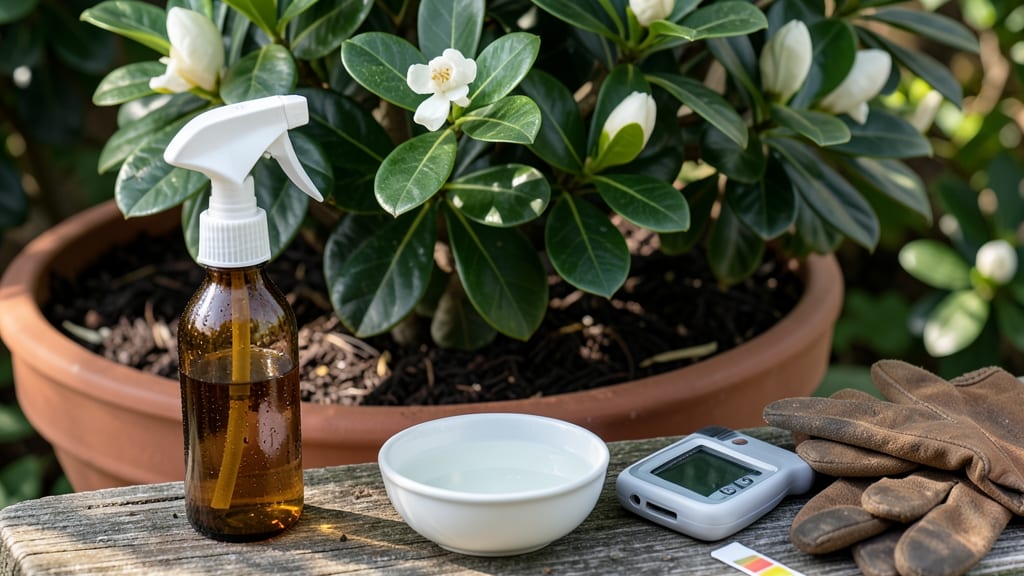
Using vinegar for gardenias can harm their health by lowering soil pH too quickly, causing leaf burn, stunted growth, and reduced blooms due to acidity imbalance. Gardenias thrive in slightly acidic soil (5.0–6.5) and require gradual pH adjustments, never sudden acidification from vinegar.
Gardenias are famously picky about soil conditions, and vinegar’s high acetic acid content can throw their delicate balance off-kilter. 🌿 The problem isn’t just the acidity level—it’s the speed at which vinegar changes pH, which can shock the roots and disrupt nutrient absorption.
Instead, I recommend using organic amendments like pine needles or crushed eggshells, which release acidity slowly over time. These methods mimic natural forest floor conditions while keeping your gardenias happy and blooming.
For those who want to test their soil’s acidity, a simple DIY pH test using red cabbage juice or a store-bought kit can help monitor progress. If you notice yellowing leaves or buds dropping prematurely, it’s a clear sign the soil has become too acidic.
At that point, mixing in lime or wood ash can help restore balance—but always do so gradually to avoid another pH swing.
💡 In This Article
- How Vinegar Alters Soil Chemistry for Acid-Loving Plants
- Safe Alternatives to Lower Gardenia Soil pH Naturally
How vinegar alters soil chemistry for acid-loving plants
When you pour vinegar into gardenia soil, you're essentially introducing a concentrated dose of acetic acid—typically around 5-8% in household vinegar. This creates a rapid pH drop that can send soil acidity plummeting below 4.5, far beyond the 5.0-6.5 range where gardenias thrive.
The acetic acid dissociates into hydrogen ions (H+) and acetate ions, with those H+ ions being the primary culprits. They bind to soil particles and displace essential nutrients like calcium, magnesium, and potassium, making them unavailable to plant roots. 🔥
The real damage happens at the microscopic level. Vinegar's sudden acidity disrupts the soil's cation exchange capacity—the natural process where soil particles hold onto nutrients for plant roots to absorb.
Gardenias particularly need iron and manganese in their slightly acidic environment, but vinegar's shock treatment can leach these micronutrients away or render them insoluble. You might notice brown spots on leaves or yellowing between veins—classic signs of iron deficiency—because the plant can't access what's now chemically locked away.
What makes this worse is vinegar's volatility. Unlike organic amendments that release acidity gradually, vinegar's effects are immediate and temporary.
The acetic acid can evaporate or be broken down by soil microbes within days, leaving behind a soil that's now nutrient-depleted and potentially saline from the sodium content in most vinegars.
This creates a false sense of security—you might think the plant is recovering, but the underlying damage to root systems can persist for months.
For comparison, consider how a gardenia's natural habitat mimics this gradual acidification. In their native forests, fallen pine needles and leaf litter slowly decompose, releasing organic acids over time. This process maintains a stable pH while providing beneficial humus.
Vinegar, by contrast, acts like a chemical shock treatment—similar to how you might use bleach to sanitize a surface, but with far more destructive consequences for living plants. 🌱
The ideal approach would be to use amendments that mimic nature's slow release. For instance, elemental sulfur or aluminum sulfate can lower pH over weeks rather than hours, while also providing sulfur—a nutrient gardenias actually need.
These materials work by forming sulfuric acid in the soil, which is less aggressive than acetic acid but equally effective when applied correctly. The key difference is the timeframe: gradual acidification allows plants to adapt rather than suffer from chemical shock.
You can visualize this difference by imagining two scenarios: one where you dump a gallon of vinegar on your gardenia bed, and another where you spread a thin layer of pine needles around the base. In the first case, you're essentially giving your plant a chemical burn.
In the second, you're replicating the natural conditions that gardenias evolved to thrive in. The pine needle scenario might take months to show results, but those results will be sustainable and healthy for your plant.