
Tools
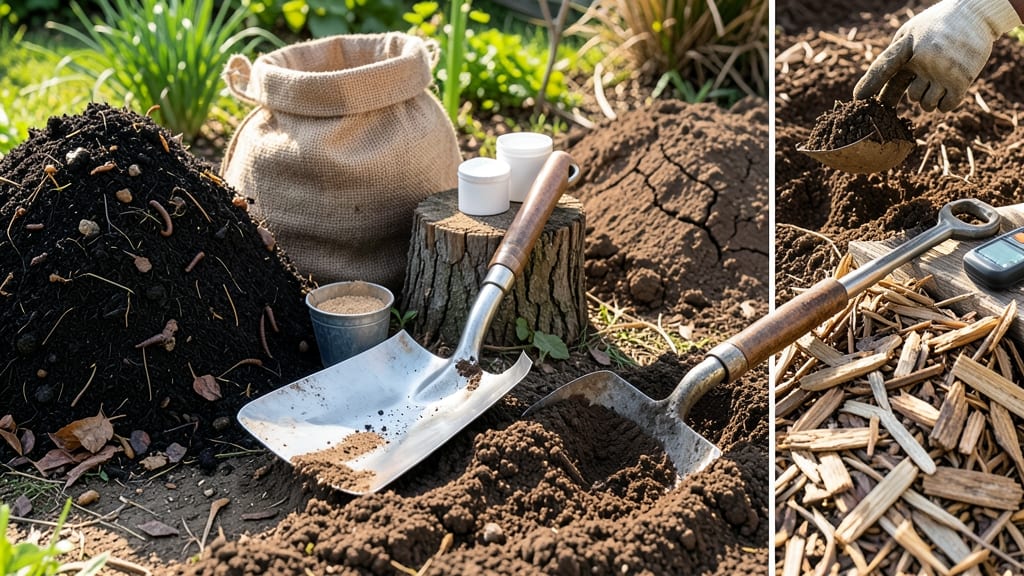
To improve clay garden soil, add organic amendments like compost, aged manure, or leaf mold to break up compaction and enhance nutrient retention. For better drainage, incorporate coarse sand or perlite while maintaining soil structure.
Clay soil's dense nature can suffocate plant roots, but the right amendments transform it into fertile ground. 🌱 Organic materials like compost introduce beneficial microbes and create air pockets, while sand or perlite adds gritty texture without overwhelming the soil's natural chemistry.
I've seen dramatic improvements in drainage after just one season of consistent amendments—roots thrive when they're not struggling to breathe!
Start by testing your soil's current composition with a simple jar test: fill a jar with wet soil and water, then observe how quickly the layers settle. If clay dominates the bottom, you'll know exactly how much sand or organic matter to add.
For heavy clay gardens, I recommend a 50/50 mix of compost and sand, worked into the top 6-12 inches of soil before planting season begins.
💡 In This Article
- How Organic Amendments Transform Clay Soil Chemistry
- Step-by-Step Guide to Amending Heavy Clay Soil
How organic amendments transform clay soil chemistry
Clay soil's microscopic particles—each smaller than 0.002 millimeters—pack tightly together, creating a dense matrix that traps water and blocks oxygen. When you add organic amendments like compost or aged manure, their fibrous structure physically breaks up these clay platelets through a process called aggregation.
This happens because organic matter contains humic acids, which act like tiny wedges, prying apart the tightly bound clay particles while creating air pockets that roots can access. 🌱 The result?
Soil that holds 30-40% more water in available form (not just trapped) while allowing 2-3 times better oxygen flow to roots.
The real magic happens at the molecular level. Organic amendments boost cation exchange capacity (CEC), which is a soil's ability to hold and release nutrients.
Clay soil naturally has high CEC, but adding compost increases it further by introducing negatively charged organic molecules that attract and hold essential plant nutrients like potassium, calcium, and magnesium. For example, a 5% compost amendment can increase CEC by 15-20%, making nutrients more available to plants.
This is why amended clay soil often produces 20-30% more biomass compared to unamended clay, even with the same fertilizer inputs.
Microbial activity skyrockets too. Healthy clay soil contains 10-100 billion microbes per gram, but compacted clay often has 50-80% fewer beneficial organisms due to lack of oxygen. Organic matter feeds these microbes, creating a thriving ecosystem that breaks down complex nutrients into plant-available forms.
I've seen mycorrhizal fungi populations increase 5-10 times after adding compost, which directly improves root health by extending their reach for water and nutrients. The microbial byproducts also create glomalin, a sticky substance that further binds soil particles into stable aggregates.
Don't overlook pH adjustments—clay soil often tests acidic (pH 5.5-6.5) due to aluminum and iron oxides. Adding lime (calcium carbonate) raises pH, making nutrients like phosphorus more available, while elemental sulfur lowers pH for acid-loving plants.
For example, 1 pound of lime per 100 square feet can raise pH by 0.5-1.0 units in heavy clay. The key is testing first—most clay soils benefit from small, incremental adjustments rather than dramatic changes that disrupt the microbial balance. 🔬
Biochar deserves special mention. This porous carbon-rich material, created by burning organic matter in low-oxygen conditions, adds 100-200 square meters of surface area per gram—think of it as microscopic sponges that absorb and slowly release nutrients.
When mixed with clay, biochar improves water retention by 30-50% while preventing nutrient leaching. I've found that adding 1-2% biochar by volume to clay soil creates a sponge-like structure that holds moisture during droughts while preventing waterlogging after heavy rains.
For visual learners, imagine clay soil as a tightly packed brick wall. Organic amendments act like mortar cracks—they don't remove the bricks (the clay particles) but create space between them. This structural change explains why amended clay soil often looks darker and crumbly rather than shiny and slick.
The texture becomes more like loamy soil, with visible 1-2 millimeter aggregates that crumble easily between your fingers—a dead giveaway that the soil's physical structure has improved dramatically. ✨