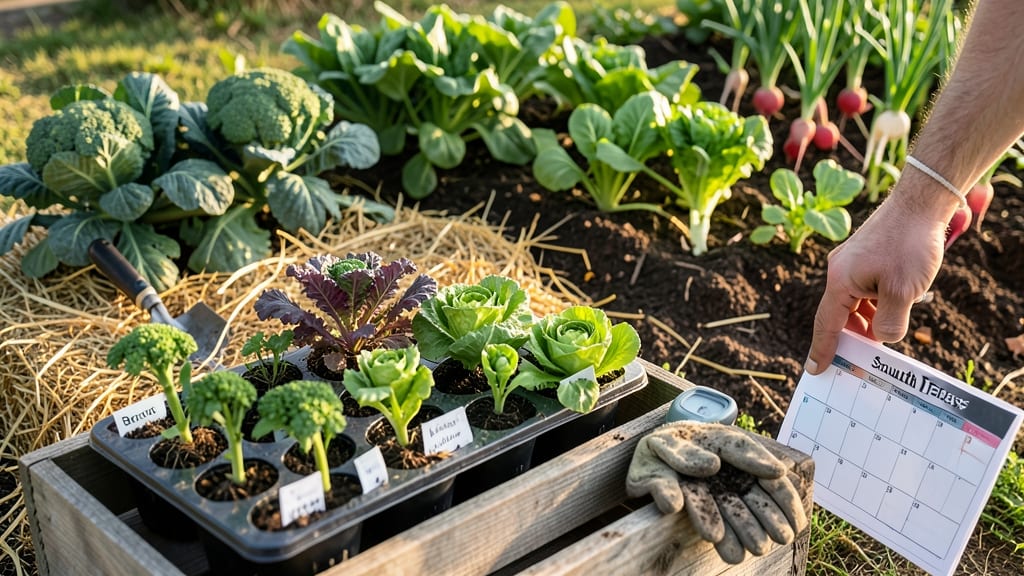
Planting a fall garden in South Texas starts in late summer—between August and early October—when the heat still lingers but the days grow shorter.
South Texas gardeners face a unique challenge: scorching summers and unpredictable frost dates—but timing your fall garden just right can mean the difference between a bountiful harvest and wasted effort.
The key is working with the heat instead of fighting it, and knowing which crops can handle the transition from summer to cooler weather.
With 300+ frost-free days in zones 9a-10a, you’ve got more time than most regions, but that doesn’t mean you can wait too long. Some crops, like malabar spinach and black-eyed peas, thrive in the residual summer heat, while others, like kale and collards, need cooler temps to really shine.
Here’s what you need to know: the best planting windows by crop type, how to prep your soil for the shift in seasons, and the game-changer strategies to protect your harvest when the first cold front rolls in.
🌱
When to Plant Fall Garden Vegetables (General) Garden Vegetables (General)
Jan
❄️
Feb
❄️
Mar
🌱
Apr
🌱
May
🌸
Jun
☀️
Jul
🌱
Aug
🌱
Sep
🌱
Oct
🌱
Nov
🌱
Dec
❄️
South Texas fall planting timeline: heat zones, frost dates, and critical deadlines
Timing your fall garden in South Texas requires precision—balancing USDA Zones 8-9 heat retention with unpredictable frost dates. Unlike northern climates, South Texas rarely freezes, but cool-season crops still need the right window to thrive before temperatures dip.
In San Antonio (Zone 8b), the average first frost hits around December 1, while Brownsville (Zone 9a) sees frost only every 5-10 years. This means your planting deadlines hinge on heat tolerance, not frost.
Start by noting that warm-season crops like okra and sweet potatoes can handle late summer heat, while cool-season greens (e.g., kale, lettuce) need cooler temps to avoid bolting. My rule of thumb? Plant heat-lovers by late August and cool-season crops by mid-September to ensure harvests before potential chills.
Below, I’ll break down the month-by-month deadlines for both groups, tailored to South Texas’s unique climate.
📅 Key Dates to Mark:
- August 15: Last chance to direct-sow warm-season crops (e.g., black-eyed peas, cowpeas).
- September 1: Ideal start for cool-season transplants (e.g., broccoli, cabbage).
- October 15: Final deadline for lettuce and spinach to avoid bolting.
- November 1: Overwintering crops like collards can handle cooler temps.
🌡️ Heat Zone Nuances: South Texas’s Zone 9a (e.g., Brownsville) stays warmer longer than Zone 8b (e.g., San Antonio). In Zone 9a, you can push cool-season crops until October 31, while Zone 8b gardeners should start greens by September 15 to avoid frost risk. Always check your local frost-free date—even a light freeze can damage tender crops like basil or cucumbers.
🌱 Warm-Season Crops (Plant by Late August):
These thrive in 90°F+ soil and need 60-90 days to mature. Examples:
- Okra (55-65 days to harvest)
- Sweet potatoes (90-120 days)
- Black-eyed peas (60-70 days)
- Cowpeas (60-80 days)
Pro Tip: Use shade cloth (30-50%) to protect seedlings from August’s scorching sun.
🥬 Cool-Season Crops (Plant by Mid-September):
These prefer 60-75°F soil and 30-80 days to harvest. Prioritize:
- Lettuce (30-50 days; choose heat-tolerant varieties like ‘Black Seeded Simpson’)
- Kale (50-60 days; ‘Texas Blue Wave’ overwinters well)
- Spinach (40-50 days; Malabar spinach tolerates heat better)
- Collards (60-80 days; harvest before hard frost)
Warning: Avoid planting bolting-prone greens (e.g., arugula) after September 15.
| Month |
Action |
Crops to Plant |
Notes |
| Late July |
Soil Prep |
Work in compost and aged manure |
Aim for pH 6.0-7.0; South Texas soil is often alkaline. |
| August 1-15 |
Direct Sow |
Okra, Sweet Potatoes, Black-Eyed Peas |
Use shade cloth for seedlings; water deeply daily. |
| August 16-31 |
Transplant |
Tomatoes, Peppers, Eggplant |
Hardening-off seedlings for 10 days before transplanting. |
| September 1-15 |
Direct Sow |
Lettuce, Spinach, Radishes |
Choose heat-tolerant varieties; succession plant every 2 weeks. |
| September 16-30 |
Best heat-resistant fall crops for South Texas: what to plant after summer’s last scorcher
After South Texas’s brutal summer heat finally eases, your garden doesn’t have to become a wasteland waiting for cooler weather. The key is selecting heat-tolerant fall crops that thrive in lingering warmth while setting you up for a long harvest season.
These varieties can handle 90°F+ temperatures and still produce before the rare December frost rolls in.
I’ve grown these crops in USDA Zone 9a/9b for years, and they consistently deliver—whether you’re aiming for quick harvests before frost or hardy plants that overwinter. The secret? Succession planting in August-September and choosing varieties bred for heat resistance and fast maturation.
⚠️ Heat-Resistant Crops: Pros & Cons
🌿 Fast-Maturing Greens
Pros: Ready in 30-45 days, shade-tolerant, bolting-resistant.
Cons: Needs consistent moisture, short harvest window.
Best for: ‘Black Seeded Simpson’ lettuce, ‘Florence F1’ Swiss chard
🌶️ Heat-Loving Legumes
Pros: Fixes nitrogen, drought-tolerant, overwinters easily.
Cons: Needs warm soil to germinate, attracts pests.
Best for: ‘Purple Hull’ peas, ‘Black-Eyed Susan’ cowpeas
🍆 Tropical & Succulent Crops
Pros: Thrives in heat, no frost damage, continuous harvest.
Cons: Needs rich soil, slow to establish.
Best for: Malabar spinach, ‘Black Beauty’ eggplant
For leafy greens, I swear by ‘New Zealand spinach—it’s the ultimate heat survivor and keeps producing until frost. Plant seeds 1/4-inch deep in well-draining soil with 3-4 inches of compost mixed in. Space rows 12 inches apart to allow airflow and reduce bolting.
If you’re craving homegrown tomatoes, opt for ‘Heatmaster’ or ‘Solar Fire’ varieties. These cherry tomatoes ripen in 55-60 days and handle 95°F+ temperatures like champions. Stake plants 6 feet tall and mulch with straw to retain moisture. Pair them with basil to repel pests naturally.
Don’t overlook collard greens—especially ‘Texas Blue Wave’. This variety overwinters beautifully and becomes sweeter after light frosts. Direct-sow seeds 1/2-inch deep in full sun to partial shade, spacing plants 18 inches apart.
They’re drought-tolerant once established, making them perfect for South Texas’s unpredictable rains.
For a low-maintenance option, try ‘Okinawan’ sweet potatoes. They thrive in heat, improve soil health, and store for months. Plant slips (not seeds) in well-draining, sandy loam with 1-2 inches of compost.
Hill soil around stems as they grow to encourage tuber development. Harvest before first frost by carefully digging around the base.
Pro tip: Succession plant every 2 weeks from August through September to ensure a continuous harvest. Use drip irrigation to keep roots cool and water deeply early in the morning to prevent fungal issues.
With these heat-resistant crops, your fall garden will stay productive long after most gardeners have packed it in.
★★★★★4.5(14 reviews)
|